Start with the routine you actually have
Describe an ordinary day as it happens now: who provides care, where the dog rests, how outings are organised and what happens when the household becomes busy. Compare that with the plan made before arrival. A change may be sensible adaptation rather than a failure to follow the original list.
Keep the review concrete. The statement evenings are difficult leaves several questions unanswered. Note which part of the evening creates the problem: a delayed handover, a crowded room, supplies that are hard to find or an unresolved concern about the dog. Different problems need different responses.
Keep what has earned its place
Identify a few arrangements worth retaining. Perhaps the current storage hook makes walking equipment easy to check, a written care note prevents duplicate tasks or a quieter resting position suits the household. Record the reason it works so that a later change does not remove the useful feature by accident.
Choose one manageable adjustment
Select an issue the household can describe and act on. If people disagree about whether a task has been done, change the handover record and agree who updates it. If equipment does not fit as intended, return to the measurements and maker’s instructions. Avoid replacing several unrelated products at once simply because the overall month felt demanding.
State how you will tell whether the adjustment helped. For a storage change, the test might be whether the needed item can be found and returned without a search. For a care note, ask whether the next person can understand it without another message. Keep professional questions with the appropriate professional rather than turning every concern into a household experiment.
Leave space for questions that need help
Write down unresolved concerns and the person or organisation to contact. The rescue may clarify handover information, a manufacturer can answer a product question, and a veterinary or qualified behaviour professional can address individual care concerns within their role. A month of ownership does not require you to interpret every observation unaided.
Do not postpone a concern merely because a familiar online timetable says the dog should need more time. Equally, a calendar date does not demand a bigger outing or a new training challenge. Use individual guidance and the dog’s actual circumstances to decide the next step.
Update the current version of the plan
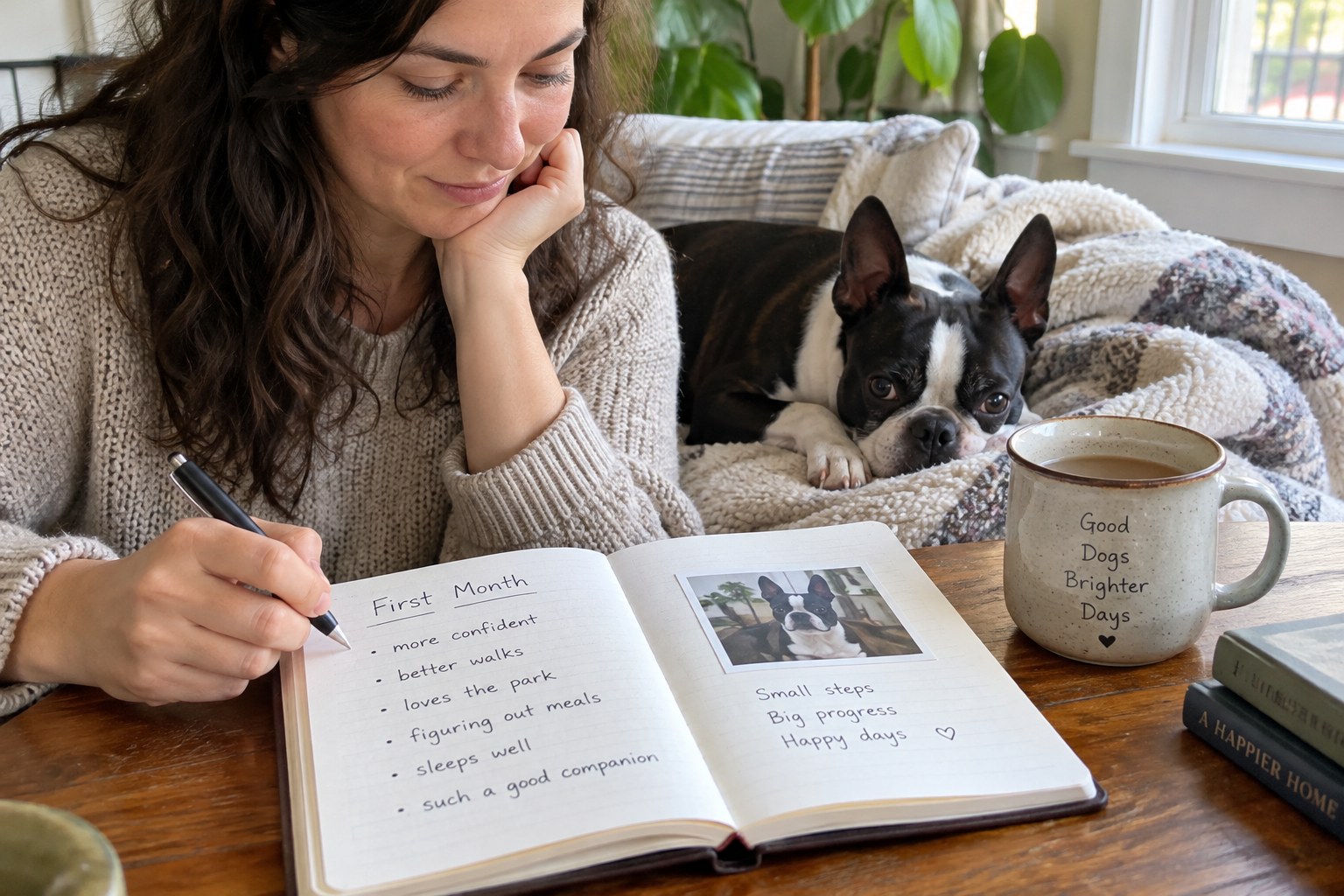
Keep a short dated summary of what stays, what changes and what needs follow-up. Tell everyone involved in care and remove outdated instructions from the active handover page. The review should make the next ordinary week easier to organise, with a few clearer decisions rather than a new list of expectations for the dog to satisfy.